-

- Finland
- +358 (0)50 4625 675

ArtRadius Saksala |
|
international artist-in-residence program in rural Finland |
- NEWS
- NEWSLETTERS
- EU-CITIZEN IN FINLAND
- MIKKELI - WINTER WAR
- HISTORY HAUKIVUORI
- HISTORY SAKSALA
- SAKSALA TODAY
- RURAL ART VILLAGE
- SUPPORT SAKSALA
- AREFS FUND
- SAKSALA IN THE PRESS
- GREEN ECONOMY
- MARJA DE JONG
- GALLERY ABOVO
- SYMPOSIUMS
- ARTISTS-IN-RESIDENCE
- ARTISTS-IN-SAKSALA
- ART-PROJECTS
- CONTESTS
- LABYRINTH
- STUDIO-IN-FIELD
- MUSIC PERFORMANCES
-
TRANSCULTURAL EXCHANGE - RENT EXHIBITION SPACE
- ARTS & CRAFT
- DEADLINES FOR CALLS

 ALLAPRIMA MUSEUM
- GENERAL INFORMATION
- TOURIST INFO
- TOURIST LINKS
- CHILDREN AND ART
- PRICES
- CONDITIONS
- RESERVATION
- GUEST IMPRESSIONS
education
InSEA art education congress
|
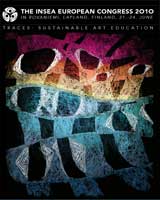 |
The InSEA regional congress is organized by the university of Lapland.
 |
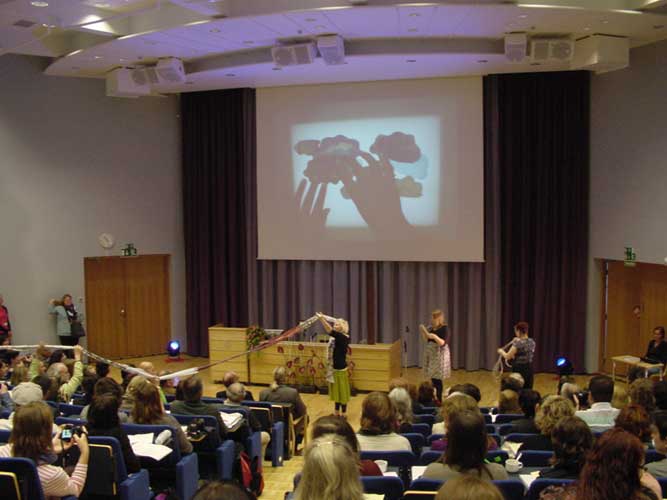 |
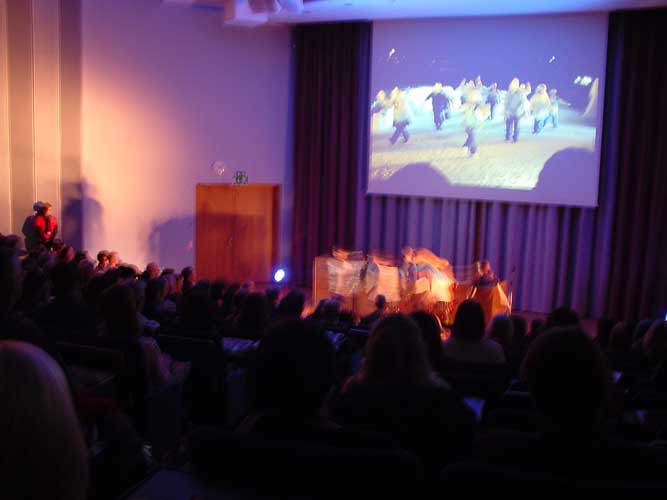
Opening ceremony on Monday June 21 2010. Over 400 peoples are attending the congress.
Scientific Program with the Major Theme
Sustainable Art Education
The theme of the congress challenges art educators and researchers to present,
compare, and develop functions that support the goals of sustainable development
through art. Sustainable development is understood as continuous and controlled
societal change taking place at global, regional, local levels. Its aim is to
secure good living possibilities for present and future generations.
Traditionally, sustainable development has been connected with the environment
and economy, but it also entails a strong social and cultural dimension. Art and
education are changing at the national, regional, and global levels, which poses
a challenge for art educators to check and update their views and practices and
to develop art education that supports social wellbeing, equality, prevention of
alienation, cultural interaction, and diversity.
The congress sets a challenge to examine how the education of art, in pursuance
of sustainable development, creates teaching and learning situations in which
the sociocultural reality of local communities encounters wider cultural
consciousness and deeper social observation. Thus, the congress breaks down the
superimposition of the local, the glocal, and the global. It also explains how
artistic activity becomes part of concrete and responsible interaction,
reflection, dialogue, critical thinking, and change orientation.
Sustainable development also requires an interdisciplinary, inter-artistic, and
holistic approach. The congress encourages the participants to treat the theme
from many perspectives and welcomes the representatives of various fields of
science and art to examine and shed light on the relation of art education to
the subsections of sustainable development, which are the following:
* Ecological and environmental sustainable development
* Social sustainable development
* Cultural sustainable development
* Economic sustainable development
information |Marja de Jong | mobile 00358 (0)50 4625 675 | info@arefs.org |
copyright |
zoeken |
zomergasten |
kunstenaars |
omgeving |
|
art links |
HOME |
search |
summerguests |
artists |
surroundings |
|
links |
privacy |
etsi |
kesävieraat |
taiteilijat |
ympäristö |
|
support |